"A man ought to read just as inclination leads him, for what he reads as a task will do him little good."—Samuel Johnson
| Reviews | Limericks | Six Words | Buy Nothing |
7 May 2026
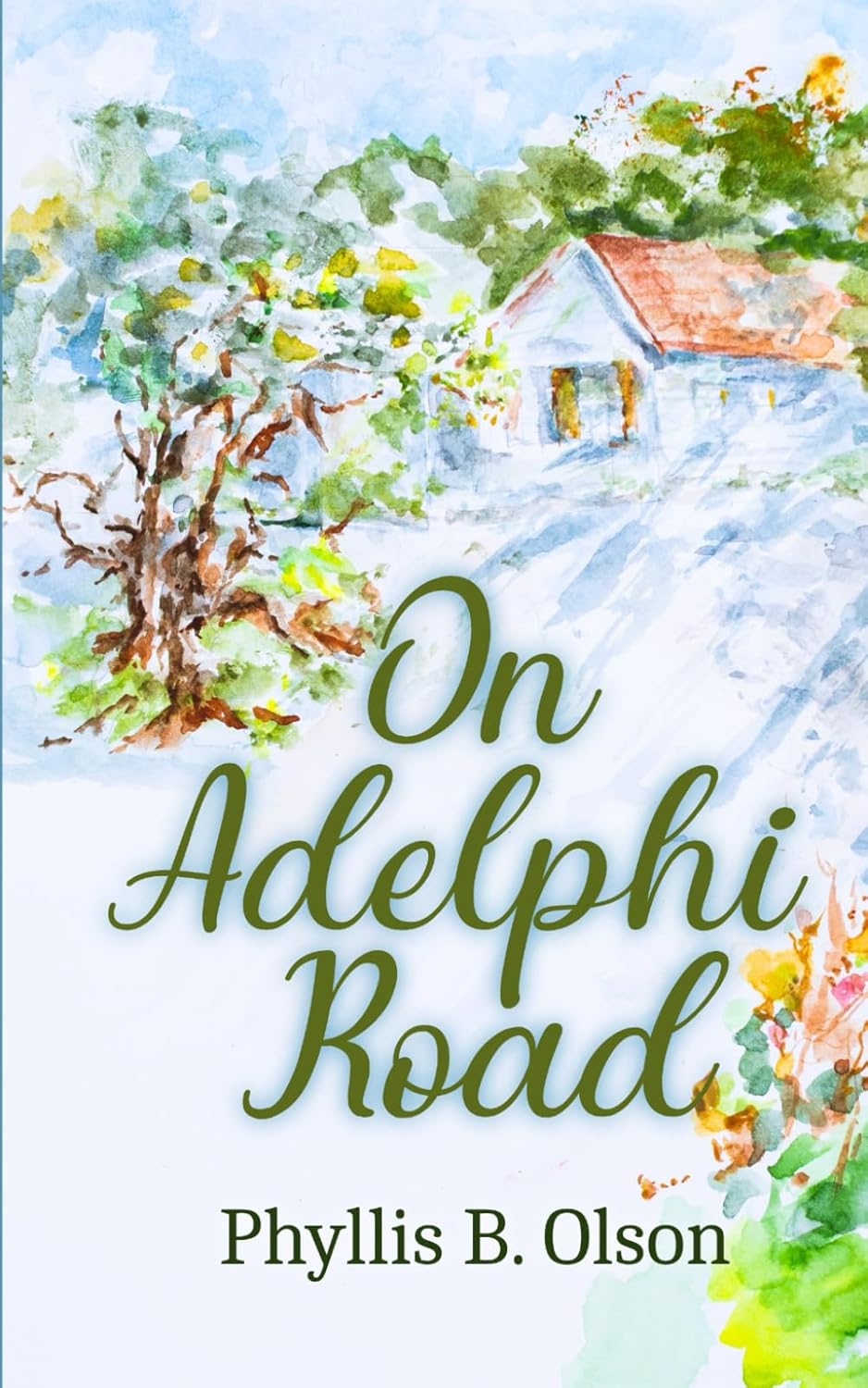
On Adelphi Road
Phyllis B. Olson
Olson's second book continues the story of Phoebe, her three kids, her unreliable husband, and her cat named Eleanor Roosevelt in their new home in the Arkansas Delta during the second world war. The conflict in Europe is thousands of miles away from the deep rural American south, but it's heard in air raid sirens and felt constantly in rationing, and ever-present in the worry of families for the fate of their sons and brothers. More immediate threats loom as well, like rheuamatic fever and polio. Childhood before vaccines was a perilous time. Again, it's the details that Olson uses so vividly to create a world: a bag of oleo margarine with orange dye mixed in to make it look like butter; a recipe for Blackberry Jam Cake; 85-year-old pickup-driving Aunt Mozelle who teaches everyone to make soap. In Phoebe's words, "Life is tough. But it's good." For those who can remember this era her writing will certainly spark memories, for the rest of us it's invaluable in preserving history.
See also The Faded Blue House
14 April 2026
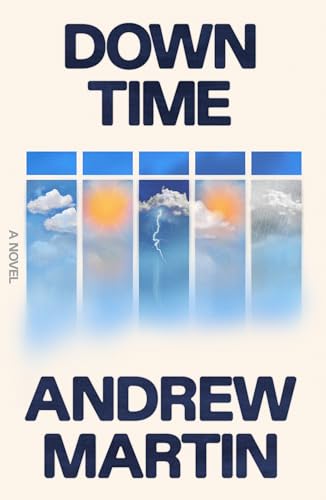
Down Time
Andrew Martin
Martin’s plotless yet compulsively readable novel takes turns getting inside in the heads of four different characters. They are two women and two men, but they’re all pretty much the same: writers/academics who do a lot of drinking and drugging and have degrading sex with whoever crosses their path, while stumbling into marriage and parenthood. They don’t converse; being millennials, they communicate by trading witticisms. Everyone is Jim Halpert, smirking conspiratorially about all the weirdos (that is, other human beings) they’re forced to tolerate. These are people who are scrupulous about checking their privilege while their parents bankroll them: “It was fun to have come from money as long as you knew you didn't deserve it.” They are the very worst people—faithful disciples of woke dogma but also unwilling to put on a mask during a pandemic. People who think they’re doing a good deed by giving a random bicycle cop the finger. People who congratulate themselves on their twisted misanthropic takes like “Really, having children was the last socially acceptable redoubt of the notion of genetic superiority, if not full-on race pride.” Or this, about a grandmother with “unpleasant political opinions”: “[She was] willing to sacrifice herself so that her grandchildren could have ‘opportunities’, never mind that the death of a barely mobile eighty-year-old would likely not do much to move the needle on the country's GDP.” So what’s going on here? Martin is smart. As in his early work (which includes a novel titled Early Work), he has insightful things to say about the craft of writing and the art of teaching. So I was hopeful when I saw a possible clue, dropped not once but twice. First, in a character’s words about his popular novel: “Savvy readers would recognize that he was above his material while still reaping the benefits of approval from the les discerning masses.” Then, later, the same character talks about Raymond Chandler “roping in the mystery people with the subject matter, while signaling to those in the know that the language and atmosphere were the real achievement.” A book doesn’t have to be an instruction in morality, it’s far better if it’s not. But there was plenty of room here to explore the characters’ shared mindset, to give it some pushback, and I guess the choice not to might sadly be my answer.
24 March 2026
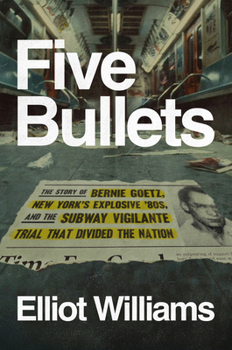
Five Bullets: The Story of Bernie Goetz, New York's Explosive '80s, and the Subway Vigilante Trial That Divided the Nation
Elliot Williams
Like the Challenger book, this is a deep dive into a big news story of the 1980s. And like the Challenger book, it's about something we all know the basic outline and ending of, but not necessarily the details. In this case, no one can say for sure exactly what happened in December 1984 on the New York subway between Bernard Goetz and four young men who were on their way to rob arcade machines, and no one ever will. What's not in dispute is that Goetz pulled out his gun and shot all four men, and one would never walk again. Williams does a fantastic job of bringing us back to the days of Ed Koch and young Rudy Giuliani and Al Sharpton, helped by grainy photos of shaggy-haired men in baggy suits and big glasses. He fleshes out Goetz, who has never been reticent with his thoughts, often to his detriment. There are definitely second acts in American life: I had forgotten about Bernie Goetz the vegetarian activist and friend to squirrels. Williams tries to draw a line between Goetz and modern Trump supporters, but the main takeaway from this book, and from any observation of modern American life, is that letting public disorder fester unchecked serves no one. Whether it's the Daniel Penny case, which Williams mentions, or this tragedy from the days when the subway was a graffiti-coated metal box where the lights constantly flashed on and off, it's clear that citizens taking the law into their own hands cannot end well. Maybe Goetz needed professional help, certainly Jordan Neely needed much more than he got. And it needed to not be so easy for Goetz to carry around a gun.
17 February 2026

The Ten-Year Affair
Erin Somers
Cora and Sam each escaped from Brooklyn to a town in the Hudson Valley with their respective spouses and small children. They meet in a baby group (I think that's what it is? I'm not up on the terms) and begin—not an affair, not a friendship, more of an orbit around each other. The novel is third-person from Cora's viewpoint, and the affair is mostly conducted inside her head, running on an alternate track to their real lives. In those real lives, they collide and acknowledge their mutual attraction. They attempt to befriend each other's spouses. They go on an ill-advised joint family vacation. Sam is revealed to be hapless but charming. That is, if you think being able to flip a toothpick in one's mouth lengthwise, only gagging a little, is charming (I don't). Cora is bored with her husband, who has a serious pot addiction but is otherwise pretty terrific. It's hard to tell how realistic it's supposed to be, as the real world often seems as fanctiful as Cora's imaginary one. Their spouses are weirdly oblivious, or are they conspiring themselves? There's lots of ribbing of millennial upstate New York culture (if you liked Portlandia, you'll like this). I loved it.
 I also read most of The Rest of Our Lives, by Ben Markovits, but ran out of steam. Kind of like his sentences, which often trail off into ellipses…for this he was shorlisted for the Booker Prize?
It's about a guy whose gotten weary of his "C-minus marriage, which makes it pretty hard to score much higher than a B overall on the rest of your life." So after he drops his daughter off at college he keeps driving,
starting an impromptu tour of visits to his brother and a series of old friends from college, each of whom I found more interesting than him.
I also read most of The Rest of Our Lives, by Ben Markovits, but ran out of steam. Kind of like his sentences, which often trail off into ellipses…for this he was shorlisted for the Booker Prize?
It's about a guy whose gotten weary of his "C-minus marriage, which makes it pretty hard to score much higher than a B overall on the rest of your life." So after he drops his daughter off at college he keeps driving,
starting an impromptu tour of visits to his brother and a series of old friends from college, each of whom I found more interesting than him.
22 January 2026
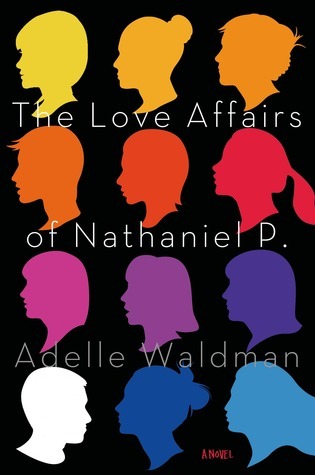
The Love Affairs of Nathaniel P.
Adelle Waldman
I know I tried this in 2014 when it first came out, and that it didn't take, and I have no idea why, as it's so far up my alley it's climbing up my fire escape. Probing the psyche of a thirty something man who makes miserable the women he dates in his New York literary circle? Sign me up. Of course I have no idea if it's an accurate representation of a man's inner life, though I don't necessarily think the author's being a woman matters. A man doesn't autoamatically understand all other men; none of us can truly get inside another person's head, much as we should try. The basic thesis is that Nate says he wants a smart woman who is a peer and who he can connect with, but when he seems to find that he gets irriated with her and discovers he's much happier with a small boned, smart but not well-read, emotionally unstable woman with perfect breasts. Seems to check out! Sure, the misogyny he's tarred with is coming from a female mind, and it's easy to believe she's projecting this as a bit of revenge for mistreatment, but it's art. It doesn't have to be a mission statement.
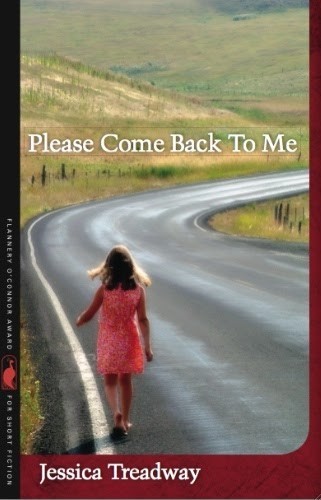 I still read the Best American Short Stories every year, despite feeling inspired to finish only a couple in each edition. Kind of like how I keep watching Saturday Night Live.
This year I especially liked Jessica Treadway's contribution, and was motivated to read a collection of hers from 2010,
Please Come Back To Me. There I found "Oregon," which is a story with the same soul of the one in the 2025 BASS, but in a longer and better incarnation.
I still read the Best American Short Stories every year, despite feeling inspired to finish only a couple in each edition. Kind of like how I keep watching Saturday Night Live.
This year I especially liked Jessica Treadway's contribution, and was motivated to read a collection of hers from 2010,
Please Come Back To Me. There I found "Oregon," which is a story with the same soul of the one in the 2025 BASS, but in a longer and better incarnation.
"There was so much to read, for one thing, and so much fine health to be pulled down out of the young breathgiving air...I was rather literary in college—one year I wrote a series of very solemn and obvious editorials for the Yale News—and now I was going to bring back all such things into my life and become again that most limited of all specialists, the 'well-rounded man.' This isn't just an epigram—life is much more successfully looked at from a single window, after all."—F. Scott Fitzgerald, The Great Gatsby
Never a spoiler.
Copyright © 1996–2026 So Much to Read
Contact: books at so much to read dot com
Copyright © 1996–2026 So Much to Read
Contact: books at so much to read dot com